

TLDR
Reclaiming your headspace starts with a conscious break from the “always-on” digital world. A digital detox provides a vital reset for the burnout and physical strain caused by constant connectivity. Small shifts like phone-free zones or the YouHabits course help you trade mindless scrolling for better sleep and sharper focus. This isn’t about quitting technology; it’s about ensuring you stay in control of your own attention.
It’s easy to feel like our phones have become an extension of our hands, and the stats back it up—WebMD reports that roughly 61% of people admit to being addicted to the internet. Between the constant “ping” of notifications, the physical strain of “tech neck,” and the mental exhaustion of comparing our lives to everyone else’s, the weight of being constantly connected is heavy. If you’re feeling burnt out and overwhelmed by the digital noise, a digital detox is the perfect solution. It’s a chance to hit the reset button, reclaim your focus, and trade screen time for the real-life moments that actually matter.
What is a Digital Detox?
At its heart, the digital detox meaning is all about making a conscious choice to reclaim your time and headspace. Think of a digital detox as a voluntary break from the “always-on” world of smartphones and social media. Instead of scrolling through notifications, you’re choosing to focus on the physical world and the people right in front of you.
You can customize this break to fit your life. A moderate approach involves setting helpful boundaries, like making the dinner table a phone-free zone. If you’re feeling completely burnt out, a total break from all tech for a few days gives your system a full reset. Finding the right digital detox strategies makes it much easier to stay on track without feeling overwhelmed.
Do I Need a Digital Detox?
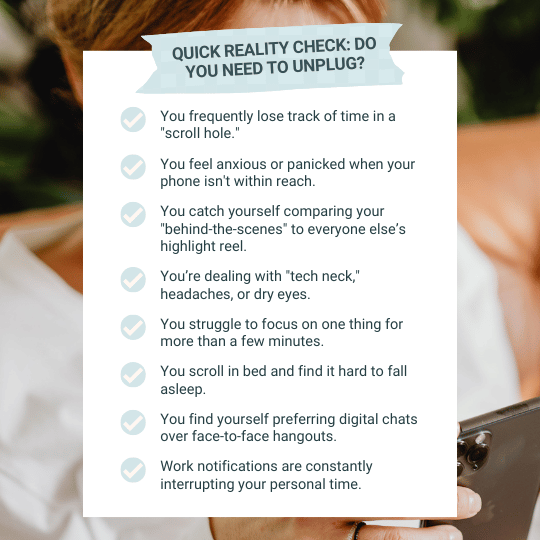
It’s one thing to know what a break looks like, but recognizing the “red flags” in your own life is how you decide if it’s actually time to step back. You might notice yourself falling into a “scroll hole,” where a quick check of a notification turns into an hour of lost time. If you feel a spike of anxiety the moment you can’t find your phone, or if you’re constantly comparing your daily life to someone else’s polished social media feed, your mind is likely waving a white flag.
Your body is usually pretty vocal about the need for a change, too. Waking up feeling groggy because of late-night blue light exposure or dealing with that persistent ache in your neck are signs that your physical well-being is taking a hit. When your attention span feels like it’s shrinking and work starts creeping into your personal time, it’s a clear signal that the digital balance has shifted.
Try asking yourself a few honest questions to gauge where you stand:
- Does using my phone leave me feeling energized or drained?
- Are my digital habits actually helping me reach the goals that matter most?
- When was the last time my phone wasn’t within arm’s reach?
Research suggests that about 25% of people under 45 can’t remember the last time their phone wasn’t right next to them. If that sounds familiar, looking into digital detox strategies can help you reclaim that lost space. Prioritizing a digital detox for mental health helps ensure you’re the one in control of your time, not your apps.
If the thought of disconnecting feels completely overwhelming, reaching out to a therapist or doctor is a great way to get extra support as you navigate these changes.
Digital Detox Benefits
If those red flags hit a little too close to home, the good news is that the benefits of stepping back show up almost immediately. Here is what you can look forward to when you finally decide to power down:
Mental & Emotional Wins
- Lowered Anxiety – Stepping away from the “never-ending stream” of news and alerts allows your nervous system to exit that “fight or flight” mode.
- Higher Self-Esteem – Doing a digital detox for mental health helps you break the habit of comparing your real life to someone else’s highlight reel.
- Improved Mood – Studies show that even a one-week break from social media can significantly boost your overall sense of well-being.
Physical Health Boosts
- Restorative Sleep – Without blue light suppressing your melatonin, you’ll likely find it easier to fall asleep and wake up feeling genuinely rested.
- Physical Relief – Your body gets a break from “tech neck” and eye strain, giving your muscles and vision a chance to recover.
- Better Posture – Spending less time hunched over a screen naturally encourages you to move more and sit less.
Presence & Productivity
- Sharper Focus – Removing the “dopamine hits” of constant notifications helps rebuild your attention span, making it easier to handle deep work.
- Sparked Creativity – When your mind isn’t being fed a constant stream of information, it finally has the space to wander and come up with new ideas.
- Stronger Connections – You’ll find yourself more engaged in face-to-face conversations, building deeper bonds that a “like” or “comment” simply can’t replace.
Once you see how much better you feel, you can start looking at the specific digital detox strategies that will help you maintain this balance long-term.
Realistic Digital Detox Strategies to Try Today
Turning those benefits into a reality starts with practical adjustments to your daily routine. Here are the most effective digital detox strategies to help you reclaim your focus:
Immediate Tech Tweaks
- Silence the noise – Turn off all non-essential alerts or lean on “Do Not Disturb” and “Focus” modes to stop constant interruptions.
- Go greyscale – Switching your screen to black and white makes your phone look less exciting and significantly reduces the urge to scroll.
- Hide your apps – Move social media or games off your home screen and into folders to break the habit of mindless tapping.
- Set hard limits – Use “Screen Time” (iOS) or “Digital Wellbeing” (Android) to set strict daily timers for your most-used apps.
Shifting Your Routine
- Create phone-free zones – Designate the bedroom or the dining table as device-free areas to protect your sleep and your conversations.
- Keep it out of sight – Leave your phone in another room or tucked away in a bag while you are working or hanging out with friends.
- Schedule your check-ins – Try checking your messages only every 30 minutes or at specific times during the day instead of reacting to every ping.
- The evening cut-off – Commit to unplugging at least one hour before bed to help your brain naturally wind down.
Analog Tools and Support
- Go old school – Swapping your digital calendar or notes for a paper planner reduces your “utility” screen time.
- The 20-20-20 rule – Give your eyes a break every 20 minutes by looking at something 20 meters away for 20 seconds to reduce strain.
- Loop people in – Telling your friends and family you are taking a break reduces the pressure to respond instantly and gives you a support system.
- Learn better habits – The YouHabits free habit course provides a structured way to build better boundaries and manage your digital time without relying purely on willpower.
Taking these steps puts you back in charge of your own attention. Making room for a break ensures your time goes toward what actually fulfills you instead of letting an algorithm dictate how you spend your day.
Progress Over Perfection
At the end of the day, remember that the goal isn’t to ditch your devices forever or live like it’s the 1800s. It’s about making sure your phone works for you, rather than you working for your phone. You might slip up and fall back into a scroll hole occasionally, and that’s perfectly fine. What matters is that you keep choosing to look up, breathe, and experience the world without a filter. Take it one screen-free moment at a time, and enjoy the quiet that follows.
FAQ: Digital Detox
There isn’t a single “right” amount of time, as the duration depends on your personal goals. Some people find that a 24-hour “digital Sabbath” once a week is enough to keep them grounded. Others prefer a deeper reset, such as a full weekend or even an entire month away from non-essential tech. If you’re just starting, try a “moderate” approach by setting daily screen-free hours before committing to a longer break.
A week-long break is a fantastic way to break the cycle of dependency.
- Day 1-2: Inform your friends and family so they don’t worry, then delete or offload your most distracting apps.
- Day 3-5: Focus on “analog” replacements. Use a physical book instead of an e-reader and a paper map for directions.
Day 6-7: Reflect on how you feel. Use this time to decide which digital detox strategies you want to keep permanently, like a strict evening cut-off or phone-free bedrooms.
Absolutely. Taking a break helps lower cortisol levels (the stress hormone) and breaks the habit of social comparison. Most people notice a significant boost in their mood and a reduction in anxiety within just a few days. It gives your brain the chance to recover from sensory overload and refocus on the real-world interactions that build genuine happiness.
Not at all. The digital detox meaning is about intentionality, not necessarily total abstinence. You can choose a “moderate” detox where you keep your phone for essential tasks—like maps or work calls—but stay off social media and news sites. The goal is to remove the “noise” and the mindless scrolling that drains your energy.
Starting small is the best way to ensure you don’t give up. Try implementing a “phone-free zone” at the dinner table or committing to the 20-20-20 rule to ease digital eye strain. You can also sign up for the YouHabits free habit course to get structured guidance on building these boundaries without feeling like you’re doing it all alone.
Pingback:What do I do if I see graphic content on the news all the time and it’s affecting my mental health? › Krysti Vo, MD