
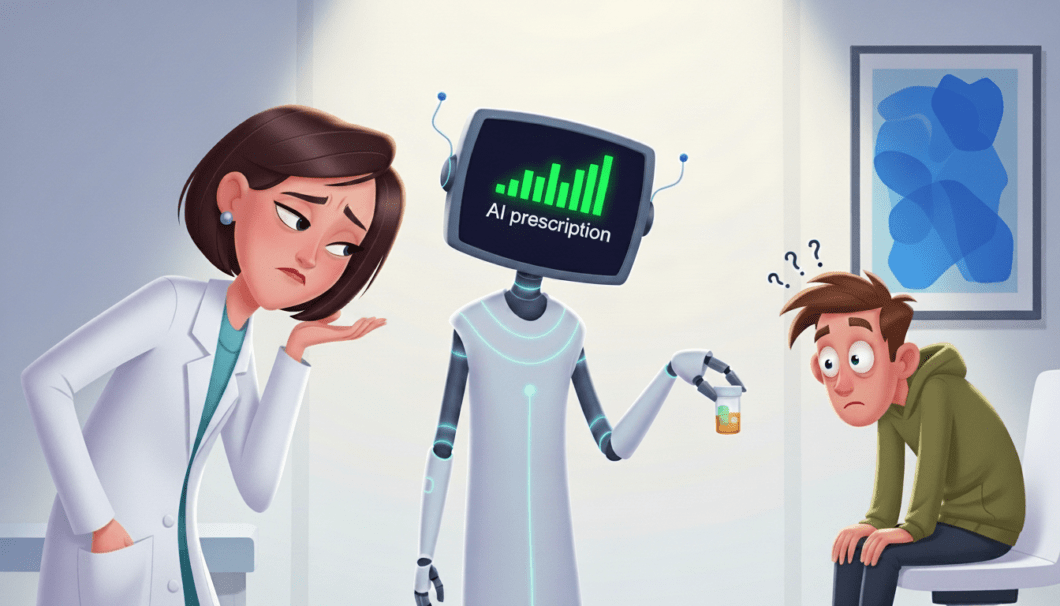
What Exactly Is Happening in Utah?
- Who qualifies? Only “stable” patients who have not been hospitalized in the past year.
- Which medications? Only non-controlled maintenance drugs, such as Prozac (fluoxetine) and Zoloft (sertraline).
Important limitation: The AI cannot start new treatments. It can only renew prescriptions that a human psychiatrist has already written.
Can the AI Adjust Your Dosage?
“Reading Between the Lines” Matters
AI follows step-by-step instructions perfectly, but it struggles to pick up on what remains unsaid. Clinical intuition isn’t a luxury; it is a safety mechanism. A human clinician spots subtle signs—weight gain, avoidance of eye contact, or a slight tremor—that suggest a medication might be doing more harm than good.
Beyond these physical signs, there are two critical “blind spots” an algorithm simply cannot see:
Insight Gap (Induced Mania/Psychosis)
Certain medications can inadvertently trigger mania or psychosis. In these states, patients often lose the ability to accurately report their symptoms. An AI asking “Are you feeling okay?” will receive a “Yes” from a patient who is currently experiencing a manic episode, potentially leading the bot to renew a prescription that is actively fueling a psychiatric crisis.
The “Sub-optimal Baseline” Trap
Patients often settle for “feeling okay” because they don’t realize how much better they could actually feel. A doctor knows how to push for total wellness, whereas a “maintenance” AI will keep a patient on a low, sub-optimal dose indefinitely. Without a human to ask, “Could we be doing better?” or “Is it time to taper?”, we miss the chance to reach an optimal therapeutic outcome.
Maintaining a Delicate Balance
Psychiatry is a constant search for the right dose. The goal is to provide effective treatment while strictly avoiding the risks of overprescribing and life-altering side effects. AI is built to give users what they want, but doctors are trained to provide what the patient actually needs. If we let AI handle refills without oversight, we lose the chance to optimize care, leaving patients stuck at a “stable” but sub-par version of health.
Doctronic Regulatory Sandbox
A separate and distinct pilot program with the developer Doctronic operates within a state-sanctioned “regulatory sandbox.” This initiative authorizes an autonomous AI agent to renew prescriptions for 192 drugs linked to chronic conditions. Utah suspended certain unprofessional conduct laws for this experiment to address structural healthcare failures, including rural clinician shortages and the administrative load of unreimbursed renewal requests. This program represents a formal deployment of an agentic system at scale, functioning under a specific legal framework rather than a subscription-based chatbot model.
“Many prescriptions for treating chronic conditions change little over time.”
The core logic for this autonomous approach centers on the fact that many prescriptions for treating chronic conditions change little over time. This inherent stability makes long-term treatments highly relevant subjects for automation experiments. Because these cases often remain consistent for years, the use of an agentic system serves as a thoughtful response to documented healthcare barriers. This experiment aims to determine if autonomous agents can safely manage routine maintenance, allowing human providers to focus their energy on complex clinical needs.
Wrapping Up
Accessibility is important, but safety must always come first. Monthly reports and pharmacist check-ins are administrative steps, but they do not replace the clinical relationship. As we watch the Utah experiments unfold, let’s not just ask if AI can refill a prescription. Instead, let’s ask if it should do so without a licensed professional making the final call on whether that medication is still the right choice for the patient’s evolving life.